The Calgary Flames Foundation is a charitable organization affiliated with the Calgary Flames NHL team. Established to support community initiatives in Southern Alberta, using the power of sport to create healthier communities.
The Opportunity:
With the government’s recent approval of the use of random ticket generators, the Foundation seized the opportunity to explore online raffles as a new channel for fundraising. This significant development opened doors to innovative approaches in engaging supporters and driving contributions.
Initially, social media campaigns were yielding only 0.05-1% of sales. There was a pressing need to explore alternative solutions to maximize outreach and fundraising potential. As a result, the foundation saw the potential for text marketing to fill this gap and sought the right solution to capitalize on this opportunity.
Working with Raange:
In search of a solution, the Calgary Flames Foundation connected with Raange through Bump, a trusted partner in their network. Recognizing the potential of SMS marketing for charities to drive engagement and fundraising efforts, they decided to leverage Raange’s platform to explore the new marketing channel.
The Text Message Marketing Results:
By implementing Raange’s SMS marketing solution, the Calgary Flames Foundation experienced significant improvements in audience engagement and fundraising outcomes. Text marketing quickly emerged as a powerful channel, accounting for 30% of their ticket sales.
Crystal Anderson, Manager of Raffle Operations at the Calgary Flames Foundation, shares her experience: “SMS marketing has allowed us to reach our audience directly, resulting in increased ticket sales and engagement. We are thrilled with our partnership with Raange. The service is great, the platform is very user-friendly and the results have been amazing.”
Bulk SMS Marketing is an effective way to reach large numbers of people at low costs. It has been used for many years by businesses to send messages to customers and prospects.
What is Bulk SMS?
Bulk SMS (also known as mass texting) is a quick and easy solution to get a consistent message to a large, targeted audience. Customers use bulk sms services to share weekly promotions, online sales, event registrations, and more.
On top of that, customers bulk sms to customers, employees, supporters and more. And with 98% open rates for SMS, it’s the quickest way to get a hold of a lot of people.
Why Should You Use Bulk SMS Marketing?
There are many reasons why you should consider using bulk SMS marketing as part of your communications strategy. Here are just a few: 1. It’s inexpensive. You only pay for every message sent, not per individual recipient. 2. It’s easy to set up. All you need is access to a phone number and a texting service provider. 3. It’s quick. Messages are delivered almost instantly.
The best thing about using bulk SMS marketing is that it allows you to communicate with a lot of people at once. For example, if you want to send a message to 100,000 people, you would be able to do so for only a couple of cents ¢.
The Advantages Of Sending Bulk Text Messages
There are several advantages to using bulk SMS messaging as opposed to other forms of communication such as email or social media. One advantage is that it is very inexpensive. Social media can be very expensive when using ad promotions to get in front of your audience. Another is that it allows you to send messages to a large number of recipients at once. You can also use it to send out promotional offers and discounts.
Examples of Bulk SMS Marketing Campaigns
There are two main types of bulk SMS messages: transactional and promotional. Transactional messages are sent when a customer has made a purchase or requested a quote. Promotional messages are sent to encourage customers to take some kind of action. These actions might include signing up for a newsletter, downloading a coupon, or making a donation.
The most common use of bulk SMS is to promote sales promotions. For example, if you sell products online, you could send a message to your entire customer base telling them about a special sale. You could also send a message to your existing customers to remind them of upcoming events or new services.
How to Find the Best SMS Marketing Software for You
An SMS marketing software is a tool that allows you to send and manage your text messages, usually via an easy to use software interface. Most of these tools come with additional features that allow you to track the engagement of your text campaigns, analyze your customers’ behavior, and generate reports on the performance of your campaigns.
Here are a few tips for finding the right text messaging software for you:
Define Your Goals: what are you trying to achieve with SMS marketing? Whether you’re trying to send messages to a lot of people in a short amount of time, drive traffic to your website, or test a new sales tool for your sales team, platforms have their own specializations.
Assess Features: Evaluate the features offered by different software, such as integrations with the tools you use. Start by creating your own list and then present that list to the different companies you’ve identified.
Integrations: We can’t say this enough times, integrations are the most important feature for many companies. Check if the software integrates seamlessly with your existing tech stack, such as CRM, e-commerce and email marketing.
Pricing: Most texting platforms advertise low prices upfront, but don’t show you the hidden costs you’ll encounter once you get the bill! Consider things like carrier fees, number of segments sent in one message, data costs, etc. We list out a few things you should check for on our pricing page.
Read Reviews and Case Studies: Look for reviews and case studies from other users to gauge their experiences with the software.
Customer Support: Always ask about customer support. You want to work with a company that wants to see your business grow and offers the subsequent support.
In addition to these benefits, there are also several reasons why bulk SMS messaging is an effective form of communication. First, it’s cheap. You only pay for each message sent. Second, it’s easy to send. All you need is a phone number and a text message service provider. Third, it’s fast. Messages are delivered almost immediately after being sent. Fourth, it’s flexible. You can use it for any type of communication, whether it’s personal or business-related. And finally, it’s scalable. If you’re looking to reach more people at once, you can simply add more numbers to your list.
Additional readings: Top 5 Best SMS Marketing Software to Send Bulk SMS!
Learn everything you need to know about sms short codes in Canada. We’ll go through the essentials, a few use cases, regulations, how to procure a short code and more.
Raange is a Canadian SMS marketing company, and a recognized messaging partner with the CWTA. We host many sms short codes in Canada for our partner companies. We know a thing or two about Canadian short codes.
What is an SMS Short Code?
A SMS short code is a 5 or 6 digit special number designed for high volume two-way text messaging. You can use short codes to send and receive MMS and SMS messages, execute large one-to-many messaging campaigns and for Text to Join.
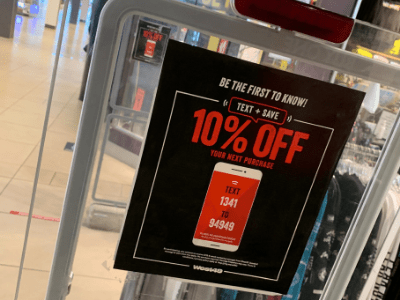
In the image above, West49 is running a Text to Join promotion using a short code 94949. Get 10% off your next purchase by texting “1341” to 94949.
The name “short code” has to do with the length of the number compared to more common ten-digit long codes. We go into more detail about the difference between sms short codes and SMS long codes in this article.
What type of organizations use short codes?
Businesses or brands planning to send very high volumes of messages use short codes. The types of organizations that use short codes include Banks, Software companies, Large Retailers, Government, Large Fast Food Chains, Health Care Companies and more.
Larger organizations also like short codes because sms short codes are much easier to remember than long 10-digit numbers. You can provision vanity short codes that either spell out a word or have a significant meaning, like PIZZA (74992) or 420420 for the cannabis industry. Your sms marketing program will be more successful with an easy to remember number.
Learn how this 100-store retailer is using short codes in their sms marketing strategy.
Read more: Engaging in a Noisy World: The Case For Suzy Shier
Short Code Use Cases
There are many reasons to use a sms short code in Canada, but we’ll go over 3 important use cases that apply to all short code programs, not just Canadian short codes.
Text to Join
Shoppers Drug Mart and many other brands use Canadian short codes to help collect opt-in customer contacts. We call these programs Text to Join.
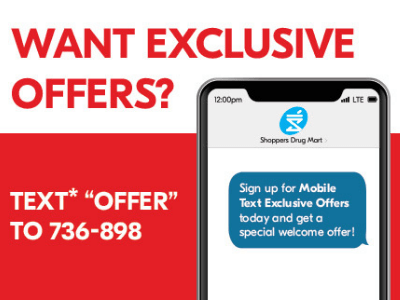
In the offer, Shopper provides a digital coupon for 10,000 PC Optimum bonus points for customers who join their text alerts program.
Two-factor Authentication (2FA)
Two-factor authentication or 2FA is another use for a sms short code in Canada. 2FA is a security procedure that requires two distinct forms of identification.
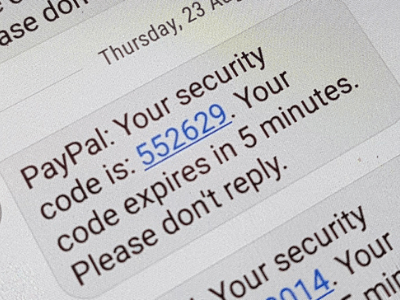
For example, when you sign into your bank account, you’ll receive a one-time password sent via SMS as your second id verification.
Time-Sensitive Marketing Promotions
Consumers love deals! There is no better way to get a time-sensitive promotion into the hands of your customer than using sms marketing.
SMS short codes are the best option to send high volumes of messages in a short period of time.
Companies will share one-time deals, digital coupons or info about sales to opt-in customers. Short codes have higher throughputs. Therefore, you can process more messages in a shorter period of time.
As we will discuss shortly, carriers vet and approve all short codes for use. Messages sent using short codes in Canada are subject to less filtering.
A few more examples we didn’t get into include sending reminder messages, tracking information for packages, e-receipts, account alerts, appointment reminders, payment reminders, chat, and many many more.
Short Code Restrictions in Canada
You cannot use short codes for international text messaging. You can only send messages in the country where the short code is registered. This is because short codes can only message users on the carriers within that specific country. In Canada, Rogers, Telus, Bell – all carriers – approve all short codes in Canada.
You can no longer use shared short codes. Meaning multiple brands cannot piggy-back off the same short code to send messages. This was a very popular technique to reduce the cost of the short code – as you can spread the cost across multiple companies.
The Canadian Common Short Code Application, set out by the Short Code Council, sets out restrictions around “adult oriented content.” This outlines limitations around age restricted content, such as services involving alcohol, tobacco, marijuana/cannabis, gaming, and any other adult oriented or mature content. Before you can start, the Short Code Council (SCC) pre-approves all short code programs in Canada.
While you’re planning your sms marketing strategy it is very important to be working with a service provider who can help you to manage the regulations around Common Short Codes or CSC’s in Canada.
Short Code Lookup Canada
Companies are always wondering what short codes are still available? The CWTA manages the Canadian short code directory. It lists all the current short codes and program details in Canada.
The CWTA charges an initial setup fee and 3-month lease of $1,500 and a monthly fee of $350 for a short code. There is also a one-time carrier provisioning fee of $3,000 paid to tier 1 aggregators. Keep in mind, these are costs associated with procuring and leasing a short code.
Once you have the short code, each messaging service provider or sms marketing software will charge their pricing plus additional carrier fees. Always ask about carrier fees!
Applying for a SMS Short Code in Canada
Working with your messaging partner will be very important in putting together a successful short code application. The Short Code Council in Canada reviews and approves all short code applications.
Your application will include program information, what it’s going to be used for, customer experience – flows, keywords and opt-ins – pre-launch forms, messaging volumes etc. It is very important to work alongside all associated parties to put together a successful application.
We tell our customers it can take up to 3-4 months for the provisioning of a new short code. Keep in mind there are always delays. There are application deadlines for new short code applications in Canada. It’s called the SMS Short Code Carrier Brownout Notice. The short code Brownout period is generally from mid-November to mid-January. This is the brownout period when SCC’s will not be provisioned. Not all applications are accepted on the first try. Make sure you’re signing up for your short code application early.
In Canada, you need to be aware of the telemarketing rules for compliance. The Canada’s Anti-Spam Legislation or CASL as set out by the Canadian Radio-Television and Telecommunications Commission (CRTC). This sets out how and when you can start sending text messages to consumers in Canada. More on this in a different article to come.
There are multiple organizations that manage short code programs in Canada. The CWTA represents companies services and products across the wireless sector in Canada. It represents the industry before all levels of government and various regulatory agencies. The CWTA is the Short Code Administrator in Canada. You can find the application here.
Once again, this entire process is best handled with your messaging partner.
How to get started with Raange?
Need to work with a company to navigate compliance and registering for a new short code program.
SMS short code marketing in Canada is simple and easy with Raange. To get started with Raange, you can also request a demo. Alternatively, you can call us at (844) 472-2643.
The Montreal Canadiens Children’s Foundation is on a mission to instill healthy lifestyles and physical activity among underprivileged youth aged 4 to 17. Their most significant source of revenue is their 50/50 draw, which they operate at all Montreal Canadiens games.
In the past, all tickets were sold in-person at home games. Recently, favorable changes in regulatory rules in Québec allowed the Montreal Canadiens Children’s Foundation to take a bold step by making the 50/50 program accessible online to the entire province, thereby opening new doors for engagement with fans across Québec and creating an opportunity to sell tickets during both home and away games.
Building a SMS program
With these regulatory changes in mind, the Montreal Canadiens Children’s Foundation saw the opportunity to explore new channels for engaging fans throughout the province. SMS marketing, renowned for its high open rates and near instant results, seemed like the perfect fit.
The Montreal Canadiens Children’s Foundation’s SMS Program scope:
Short code for high volume messaging
Regulatory compliance and approval for 50/50 raffles using text messages
Platform that can handle French accents
Partnering with Raange
The Montreal Canadiens Children’s Foundation was introduced to Raange, a Canadian SMS marketing software company based in Québec.
Raange’s platform proved to be the ideal solution, as it was equipped to handle multilingual messages, supporting the Montreal Canadiens Children’s Foundation’s bilingual communication needs, and high volume messaging, as required for one of the most storied NHL franchises.
Raange is also a recognized messaging provider and proud member of the Association of Mobile Content Council (MCC), giving the Montreal Canadiens Children’s Foundation access to experts who could help navigate compliance and regulatory hurdles.
A Win, Win Scenario
Today, text messages reach thousands of Habs fans in a timely manner, particularly on game days, resulting in surges in sales within minutes to an hour to sending a text messaging campaign. SMS marketing has evolved into a vital channel for revenue growth for the Montreal Canadiens Children’s Foundation.
Ryan Frank, Director of Fundraising and Community Engagement for the Montreal Canadiens Children’s Foundation, expressed his satisfaction: “We are very satisfied with the service at Raange. The regulatory and compliance team has helped to get the program off the ground when we thought it wasn’t possible. Now we’re raising more money to support our youth.”
Eric Nykamp, CEO of Raange, stated, “Working with the Montreal Canadiens Children’s Foundation is a dream come true for a local Montreal company. At Raange, we strive to deliver the best service when it comes to SMS engagements and push for our SMS engagements to be Faster, Cheaper, and Delivered.”
When it comes to collecting data, we’ve definitely entered a more customer-centric era. An essential milestone in this transition was the implementation of the GDPR. In combination with the CAN-SPAM Act and the Canadian Anti-Spam Law and Quebec’s Loi 25, businesses need to move toward a more transparent approach to compiling user data.
Despite the fact that these consumer privacy legislations are enforced by means of hefty penalties, we’re confident that this transition to a predominantly first-party data collection will prove to be beneficial to companies in the long run.
Or check out our video! ?
So what’s the difference?
What is first party data?
First-party data comes directly from the user. It provides marketers with a more extensive range of benefits, compared to second party and third party data.
For example, if a user filled out a contact form on your website that is first-party data.
Your audience has shared this information willingly with your brand, which includes data from website cookies, captured email addresses, and mobile numbers, or POS data.
First-party data has its benefits and limitations. First-party data is undoubtedly among the most valuable assets for a company’s marketing efforts. Your audience is showing an intent to build a more meaningful relationship with your brand.
However, just like any high-quality information, this type of data is fairly complicated to acquire.
In another blog post, we go over 3 creative ways for brands to capture first party dat.
What is second party data?
Second-party data is owned by, as you can guess, a second-party Party; ie. second-party data is someone else’s first-party data.
The owner of this data has decided at some point to share it with you. This is very common with larger organizations or using targeting in most ad platforms like Google and Facebook. You’re using data they’ve collected about their users.
Second-party data has its benefits and limitations. Companies pay vendors to use their data, but don’t actually own it. At the same time, the buyers can actually vet the data they receive, which makes it a more effective and cost-efficient approach.
What is third party data?
Third-party data is owned by a 3rd Party – essentially someone is reselling data to you. If you’re getting it from an intermediary — it’s third-party.
This type of data is abundant, and it’s for sale. However, there is one central caveat — it’s very imprecise. Furthermore, since there is a middle person involved, companies often don’t even know where it’s coming from.
Purchasing leads or customer lists are usually examples of third-party data aggregated by one company from multiple sources and then resold.
Third-party data has its benefits and limitations. The benefit of third-party data is that it’s really easy to get a hold of. However, if you’re using third-party data, then chances are that one of your competitors is using it as well.
Why focus on first-party data?
Clean and compliant first-party data has a broad spectrum of benefits like:
Better targeting.
A bigger picture on the customer lifetime value.
A better understanding of customer intent and their location in the funnel.
A more curated brand experience for consumers.
Potential for ROI-busting marketing campaigns.
It calls for a more profound and long-lasting relationship with your audience, prospects, and existing customers. In contrast, companies that rely on third-party data are prone to a more spray-and-pray approach, which results in a poor experience for the user and hurts your brand in the long run.
Empowering and motivating
Businesses must now be more thoughtful about how they collect their customer data. We’ve now shifted from just buying information behind the curtains to having a meaningful conversation about it with our potential and existing customers.
Here are a few ways how we should incentivize our users to share their data:
Provide them with a detailed description of the benefits they’ll receive.
Mention that they have total control over the types of data they choose to share.
Make the editing of privacy preferences intuitive and straightforward.
Promote consumer privacy and data stewardship.
As a result, this approach will motivate people to build longer, more meaningful relationships with the brands they take their business to.
Things have changed dramatically in the last year or so. The latest data privacy regulations have made it harder for brands and marketers to collect and use data. However, through these trials, we’re heading toward a more consumer-focused and sustainable way of conducting business and having meaningful relationships with our customers.
As digital advertising professionals brace for the impending demise of third-party cookies, the landscape of online marketing is undergoing a seismic shift. With Google’s recent announcement of phasing out third-party cookies by Q3 2024, businesses must adapt their strategies to thrive in this new era of digital privacy.
Understanding the Shift:
To comprehend the significance of Google’s decision, it’s crucial to grasp the role of cookies in online tracking. Cookies, particularly third-party cookies, have long been utilized to monitor user behaviour across the web, enabling targeted advertising based on browsing history and personal data. However, mounting concerns over digital privacy have prompted the gradual phasing out of third-party cookies, with browsers like Firefox already eliminating them.
The Impact on Digital Advertising:
With Google Chrome commanding a substantial market share of approximately 65%, its transition away from third-party cookies is poised to have a profound impact on digital advertising. As businesses grapple with this paradigm shift, the need to cultivate first-party data and grow their databases becomes paramount.
What is first party data?
First-party data comes directly from the user. This data, collected with user consent, offers invaluable insights into customer behavior, preferences, and interests.
For example, if a user filled out a contact form on your website that is first-party data.
Your audience has shared this information willingly with your brand, which includes data from the website, captured email addresses, and mobile numbers, or POS data.
First-party data has its benefits and limitations. First-party data is undoubtedly among the most valuable assets for a company’s marketing efforts. Your customers are showing an intent to build a more meaningful relationship with your brand.
However, just like any high-quality information, this type of data is fairly complicated to acquire.
Embracing the Opportunity:
In light of the impending cookieless future, businesses must proactively adapt their marketing strategies to thrive in this evolving landscape. Rather than relying solely on third-party cookies for audience targeting, investing in initiatives to grow your database and capture first-party data is essential for long-term success.
Strategies for Database Growth:
Implement Opt-In Strategies: Encourage users to provide consent for data collection through transparent opt-in mechanisms.
Offer Value Exchange: Provide incentives such as exclusive content, discounts, or rewards in exchange for opting into data collection.
Enhance Customer Engagement: Foster meaningful interactions with your audience through personalized content, surveys, and feedback mechanisms.
Leverage Multiple Channels: Utilize a diverse range of touchpoints, including websites, mobile apps, social media, and email marketing.
Prioritize Data Security: Maintain strict compliance with data protection regulations and prioritize the security and privacy of user information.
Conclusion:
As the digital landscape moves away from third-party cookies, businesses must pivot their marketing strategies towards cultivating first-party data. By prioritizing database growth and embracing the opportunity to own and leverage valuable customer insights, businesses can navigate the cookieless future with confidence and continue to deliver impactful, personalized experiences to their audience.
New requirements for privacy are now in force under Quebec’s Law 25.
The new law borrowed the best practices from other jurisdictions such as the EU.
The government wants to improve consent so consumers have a better idea of how their data is being captured and used.
Quebec is looking at increasing financial penalties for companies that do not comply with the new law.
Quebec’s new data privacy law entered into force on September 22nd. The need for a modernized privacy law should come as no surprise: big tech is tracking your every click, search, and download, and in some cases, information is being resold to third parties and used for advertising.
The Province of Quebec has decided to do something about it.
What Quebec’s new data privacy law could mean for consumers?
Three years ago, the provincial government announced a new privacy law would be tabled in the National Assembly. The bill has since passed and gives some powers back to the individual consumer, borrowing the best standards from GDPR.
“The law will give back [to the citizen] control of his data,” said the Minister of Justice, Sonia LeBel. “We are moving towards European models, and this is what is recognized as the most advanced.”
The new privacy law comes at a time when an increasing number of consumers are worried about the growing number of personal data leaks and how their information is being collected and used.
Law 25 gives increased enforcement powers the Commission d’accès à l’information du Québec, Quebec’s data protection authority. The new powers include conducting privacy impact assessments before transferring personal data outside the province and transparency requirements.
How will the new privacy law affect businesses in the province?
The concept of consent has been modernized and is a cornerstone of the law. One of the biggest changes for businesses, similar to GDPR, Law 25 also has extraterritorial reach, encompassing companies whose actions impact consumers in Quebec.
Let’s imagine you have an online store based in the United States that sells products to customers worldwide, including in Quebec, Canada. If you collect personal information from customers in Quebec, such as their names and email addresses, and use that data for marketing or other purposes, you would need to comply with Law 25, even though your business is located outside of Quebec.
This is because the law applies to companies that affect consumers in Quebec by collecting and using their personal information. So, in this scenario, you would need to ensure your data collection and usage practices align with the requirements of Law 25 to avoid legal issues.
Based on GDPR’s standards, companies would have to use plain language in their consent text, and give specific consent to the consumer to better control the usage of their data.
In addition to better data standards, the government is looking at increasing financial penalties for companies that do not comply with the new law. Penalties of non-compliance can range from $15,000 to $25 million, or 4% of the company’s worldwide turnover for the previous year – whichever is greater.
Seeing as the current law dates back to the 1990s, it’s about time the government made some updates to modernize privacy laws in the province.
Other jurisdictions will likely start modernizing their consumer privacy legislation soon as well. Most recently, we saw California implement a new law, the California Consumer Privacy Act, giving more rights back to the consumer.
What can businesses in Quebec do right now to prepare?
The most important thing is to keep an eye on what’s happening and reach out to your vendors to make sure everyone is ready to meet compliance. Don’t be afraid to ask your vendors the tough question: “Are you reselling my customer data?”
If you’re one of the companies that collect customer data and resell it to third parties, well, it might be time to start looking at a new business model/revenue stream because that won’t work anymore in Quebec.
We, at Raange, believe that transparency is core to good business.
The days are getting shorter. The nights are getting cooler. To us in SMS marketing in Canada, this means the annual short code brownout period is just around the corner.
What is the Short Code Carrier Brownout Period?
The short code brownout notice or “The Canadian Carrier Brownout” is a deadline for new short code applications for new sms marketing programs in Canada.
Canadian carriers stop provisioning (supplying) new short codes or short code migrations for a period of time between the end of October and the new year.
The Canadian Carrier Brownout is an annual carrier provisioning freeze during which new Short Codes, or changes requiring network updates to existing Short Codes, such as aggregator migrations or price point changes, do not occur.
As you will see, each carrier is different and the rules are a little cloudy, but hopefully, we can help make some sense of it.
If you’re a company thinking about starting an SMS marketing program in Canada to take advantage of the Holidays and have spec’d out the requirements for a short code (learn the basics about short codes here), you have to apply and be approved for a short code by the Short Code Council, made up of Canadian telcos.
Each application needs to be considered and approved by the carriers before you can even start your program. You can read more about this on txt.ca.
Most companies will work directly with their messaging partner, like Raange, to procure a short code on their behalf.
New short code applications are reviewed and approved every Tuesday by the Short Code Council. Those applications need to be submitted by 1:00 p.m. (ET) the previous Thursday.
When is the brownout notice?
As per Canadian Wireless Telecommunications Association (CWTA):
In order to meet the last provisioning date of 2023 and to have a Short Code provisioned or migrated by ALL CARRIERS, applications must be submitted to the Association by: Thursday, October 26, 2023 at 1:00pm ETApplications submitted by this deadline will be provisioned by the participating carriers between Nov. 14 – Dec. 12, 2023.**Applications submitted after this deadline will be scheduled for provisioning in January 2023.**
As always, the Short Code Council will continue to meet throughout the remainder of November and December to review applications for provisioning starting January 8, 2024, with Freedom, Rogers, and TELUS to follow with provisioning on January 9, 2024.
Programs will continue to be considered on a first come, first served basis; provisioning dates are dependent on the volume of applications submitted.
What are the dates for each carrier?
This is where it gets a little confusing – that’s why the above deadline is the most important if you want no hiccups!
Freedom Mobile – Applications submitted after the October 26th deadline will not be provisioned until January 8th, 2024.
Rogers – Applications submitted after the October 26th deadline will not be provisioned until January 8th, 2024.
TELUS – Applications submitted after the October 26th deadline will not be provisioned until January 8th, 2024.
ALL OTHER CARRIERS – Applications submitted after the November 3rd deadline will not be provisioned until January 9, 2024.
In conclusion
Thursday, October 26th, 2023 is the most important date if you still have the aspirations of starting an sms marketing short code program in Canada before the Holidays.
Otherwise, you have to wait until January 2024 to start your program.
If you feel like you need some help deciphering this process, we have a team of regulatory experts who work directly with the CWTA and the individual carriers to help expedite the process.
Mobile technology offers a plethora of messaging options. Whether you’re using iOS or Android, Viber or WhatsApp, you’re probably familiar with SMS and MMS. But do you truly understand the distinctions between them, especially in the realm of messaging marketing?
In this article, we’ll delve into the nuances of these two messaging platforms, allowing you to make an informed decision on which one best suits your marketing strategy. Understanding what sets SMS and MMS apart is vital for achieving exceptional results in your marketing efforts.
Setting the Record Straight: SMS and MMS
Let’s explore how businesses can leverage both SMS and MMS in their marketing strategies.
SMS for Business
SMS, short for Short Message Service, is a text-only medium that appears minimalistic but boasts a wide range of functions in Business-to-Customer interactions. Here are a few ways businesses utilize SMS to communicate with their audience:
Informing or reminding customers about changes in appointments.
Sending out advertisements about discounts and sales.
Distributing discount codes and special offers.
MMS for Business
Multimedia Message Service, or MMS, as its name suggests, is a multimedia messaging platform capable of delivering media files alongside text data. While MMS messages have no inherent character limit, service providers set size restrictions, which can range from 300 Kb to 600 Kb and beyond.
Though it may not seem like much space, MMS can be a powerful marketing tool when approached creatively. “Media files” here refer to videos, audio, and images, allowing you to distribute short audio files containing information about your latest offers.
While MMS messages may not carry extensive information, they are far from a less valuable asset. Short videos have been proven to stimulate sales, especially when crafted effectively.
Benefits of SMS Marketing
Despite being a well-established technology, SMS has gained immense popularity among marketing professionals. The key reason behind its success is the high level of engagement associated with text messages. Here are some statistics to support this:
SMS boasts a response rate nearly 8 times higher than that of email.
It takes an average person around 90 seconds to respond to a text message.
Over three-quarters of individuals use SMS messaging for business purposes.
Businesses can experience up to a 30X return on investment (ROI) on SMS marketing campaigns.
Benefits of MMS for Business
In today’s business landscape, MMS offers a wide array of applications that cater to end customers:
Advanced customer support: Tech companies, for instance, often need to provide assistance regarding accessories, gadgets, and hardware that isn’t easily explained via phone or email. MMS comes to the rescue, allowing agents to offer visual directions when needed.
Ads with visual impact: Like SMS, MMS is a highly efficient medium, especially considering how often recipients open multimedia messages. MMS boasts an impressive open rate of 98%. Unlike SMS, MMS messages do not impose stringent character limitations, allowing you to send out thousands of characters in a single message.
In Conclusion
We’re interested in hearing your thoughts on the marketing SMS and MMS messages you receive. How compelling do you find them, and how convincing are they compared to other marketing channels?
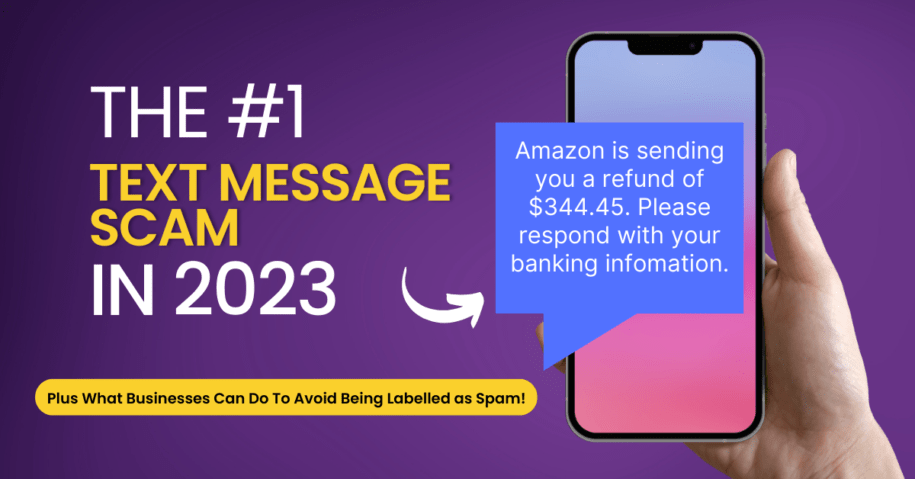
Step aside email because text messages is becoming quickly the channel of choice for scammers. When it comes to digital scams, text messages have become a popular channel for fraudsters. The Federal Trade Commission (FTC) recently disclosed the alarming scale of sms scams, revealing that consumers reported losses of over $330 million due to these scams last year alone, more than doubling what was reported in 2021.
In addition, the FTC revealed the most common form of text message scam reported to the agency, and that many of the most common text scams impersonate well-known businesses.
In a data spotlight report, the FTC found that the most reported text message scam: bank impersonations.
Bank Frauds Are #1
Perhaps the most devious revelation is that these fraudsters often masquerade as urgent security alerts or One-Time Passcodes from well-known banks such as Bank of America and Wells Fargo.
Anyone whho clicks-through or responds to the phony request would be connected to a “fake bank representative.”
How bad have fake bank texts become? Reports on fraudsters impersonating banks have increased by nearly 20X since 2019, in less than 5 years.
How to spot spam messages
While bank fraud warnings are #1, scammers don’t stop there. The spotlight report reveals four other common text message scams:
Messages claiming to offer a gifts, often from a cell phone carrier or retailer;
Fake claims of package delivery issues from UPS or FedEX;
Phony job offers for things like mystery shopping and car wrapping; and,
Bogus Amazon security alerts.
It’s important for you to be skeptical of messages coming in from numbers you don’t recognize. Often times, spam messages will come from unknown numbers and written with very poor grammar.
What can consumers do when they spot a fake?
As a consumer there are things you can do to help stop spammers:
Do not respond: if you do not respond to these messages, fraudsters will see that these methods are not working.
Do your research: If you do get a message and you’re not sure if it’s fake or real, do a quick search to see if this is a common fake text. Normally, fraudsters use automation and mass lists to simply blast the same message to lots of people.
Report the issue: You can report the issue to your cell phone company, device makers and to the FTC or the Canadian Anti-Fraud Centre.
How to avoid your business messages being perceived as spam
Avoiding your marketing text messages being perceived as spam is important to maintain a positive relationship with your contacts and engage effectively with your audience.
Additionally, if your business text number is flagged for spam, the number can be shut down by service providers. Unlocking the number can be a real headache for you and your team.
Here are some tips to help you stay away from the spam:
Get Consent: Always seek explicit consent from your contacts before sending any type of message. A clear and concise opt-in process where subscribers agree to receive messages from your business is very important.
Display Your Brand Name: Clearly display your brand name somewhere early in the messages. This way, subscribers can see who the message is from before they even open the text message.
Give Value: Send messages that offer real value to your subscribers. Whether it’s promotional offers or helpful information, your messages should provide value to your subscribers, this way they won’t forget your number.
There is a lot more you can do to make sure your messages steer clear of the spam. By following these 3 simple suggestions and maintaining a strong commitment to your brand’s core values, you can reduct the chances of your business messages being viewed as spam.