3 Ways SMS Marketing Can Increase App Downloads

Businesses that have decided to design and build an app need to find the best way to advertise their products and engage their potential customers so that the app they’ve developed doesn’t go unnoticed.

Retailers and restaurants need to go two extra miles to ensure that their product will be seen, downloaded, and used by their target customer. To show you how serious the competition is, here’s an approximate number of apps on the major app marketplaces at the beginning of 2018.

In this article, we discuss why SMS marketing is an essential component of a business’s marketing mix. Many companies decide to forgo SMS or other marketing tools to collect first-party data or contact data to focus on their app. The way we see it, this invaluable asset will help them augment their KPI’s. Let’s dive right in, shall we?

1. Why your mobile app needs SMS marketing

SMS marketing is yet to gain considerable momentum in helping retailers and restaurants improve metrics around their apps. We are confident that this specific channel will become popular and we have good reasons to believe it.

There is now a broad spectrum of industries that have embarked on the SMS marketing route and have extracted huge benefits from this marketing channel. It all started with less technological fields like hotels, real estate, tourism, and has gradually moved into more technically intricate domains of human activity like healthcare, e-commerce, and online services.

Let’s look at some SMS-related stats. What’s the most popular channel for retailers to reach their customers? “Email” is probably the first thing you thought of. Well, SMS messages get open rates that are up to five times higher, compared to emails.

Moreover, many companies and services have started integrating text messages in their workflow to minimize the number of missed appointments. Research shows that the businesses that started using this technology have seen a 26% drop in missed meetings.

Now let’s put that into perspective — imagine the growth in conversions and transitions from free trial versions to premium paid accounts a well-designed SMS marketing campaign would be able to generate soon after the release of an app.

2. Short codes Make Downloading apps even quicker

Rather than distributing links directly to your customers, retailers can also take advantage of the text-to-download function. Typically, a company will set up a short code number and include it into their ads in various mediums — commercials, banner ads, billboards, podcasts, and so forth.

By creating a simple shortcut for the user, businesses will be able to skyrocket their download KPI’s. For instance, if a client has to only send “APP” to 55555, to receive a download link, it eliminates a lot of the friction from the user path, compared to a scenario where they had to look for your app in the marketplace.

3. Higher and more calibrated engagement

Businesses can direct their customer’s attention to specific sections of their site by sending out deep links, instead of landing pages. With mobile apps, deep linking will enable you to send uniform resource identifiers (URI) that link to specific locations within an app, instead of simply launching the app.

Deep linking can be helpful when businesses roll out new features, products, or even new offers. Keeping your customers posted on the latest features you’ve introduced is known to increase customer engagement.

Furthermore, businesses can use SMS marketing as a medium for better and quicker communication.

If you’re a small company and you don’t have many support personnel, you can provide “exclusive” SMS support for Premium customers only.

Wrapping things up

SMS marketing has now become one of the marketing channels that are indispensable in a successful business’s marketing mix. The way we see it, your company will benefit from incorporating text messaging to grow the number of downloads by advertising your app via SMS or facilitating the access to your app’s page on a specific marketplace. Both are essential in this highly competitive environment.

Previous Posts You Might Like:
Let's Work Together, Elbow to Elbow

Let’s Work Together, Elbow-To-Elbow

Hi everyone.

During these uncertain times, we at Raange want you to know that we’re thinking about you, your businesses and families. 

We understand that the effects of the measures many countries have taken to avoid the spread of the virus, will force marketers to greatly rethink their strategies for the weeks ahead.  We wanted you to know that we share your concerns. 

This is an opportunity for us to join together in humanity and do good for one another.   It’s amazing what certain people are doing, from picking up groceries for the elderly to buying gift cards to help local businesses that have since had to temporarily close their doors. 

This is not a time to be idle even though many of us are confined to our couches. There are many things we can do to, not only help our businesses but to help others keep theirs and to help your customers stay connected with you. Customer acquisition opportunities remain. Optimism remains. 

If you have concerns about how to stay connected with your customers using mobile, feel free to call me directly. I’m happy to volunteer some time to help: 844.4.RAANGE #404

We at Raange have opted to tell our employees to work from home. We are fortunate to be able to do this with little disruption and we are grateful for this and grateful for you.  It’s time to come together as marketers and do what we do best. Be human.

Stay tuned.

Eric Nykamp

CEO

How to drive more online sales with sms marketing

How to drive more online sales with SMS marketing

As we continue to reach out to our customers and network, one issue that has come up during these conversations, is the need to rapidly pivot from a traditional sales channel (brick-and-mortar) to eRetail just to survive this crisis.

The only constant? You want to stay in contact with your customers, whether to alert them of store closures, changing store hours or any pertinent update about your business.

In response, we’ve been putting together some quick strategies to share with our partners that help with driving traffic to eRetail sites. Click the image below to watch a quick demo below of a SMS strategy we’re using to drive mobile coupon redemption to e-commerce sites in seconds!

As a company, we know how important it is for marketers to TEST marketing channels rapidly to compare against current channels and prove ROI – especially on tight budgets. With people spending more time on their mobile devices than ever before, companies need new ways to target their customers before they’re gone forever.

We invite you to schedule a campaign test with Raange, so that you can test a new mobile channel with no risk and no obligations. You can book a time to talk and strategize with our team here.

Cheers,

The Team at Raange

First-Party Data is the answer to new privacy laws - header image - 1200x627

3000% ROI Using SMS Marketing!

As a marketer, there is nothing more important than maximizing ROI on your marketing campaigns. But with so many different channels available today, it can be overwhelming trying to identify the next channel for you to test.

Today, we want to talk about SMS marketing, discuss a few benefits of SMS as well as share a case study showing you the results brands are getting from their sms marketing campaigns.

The benefits of SMS

Text message marketing is gradually entering a more mature stage in its development. Major businesses like Facebook, Walmart, and Google have started gradually adopting this relatively new marketing channel.

Thus significantly smaller companies now have a better understanding of how to build a better strategy that will engage their audience and dramatically increase sales.

It all has to do with the importance of SMS messages in the communication hierarchy. We, as mobile users, will very often turn off notifications from social media, apps and emails, but people very rarely choose to disregard their text messages.

That’s why SMS messages have an astonishing 98% open rate!

Furthermore, over sixty percent of smartphone users unlock their phones immediately after waking up, and nearly eighty percent within the first 15 minutes of their day.

However, SMS marketing should be analyzed from the recipient’s perspective as well. Is it safe to assume that this type of marketing brings value to the end customer?

A survey conducted by OpenMarket suggests that three-quarters of millennials consider that SMS messages and reminders are helpful, but only less than a third of them are actually receiving them from the brands and companies whose services they use.

This is suggestive of the fact that businesses need to engage in a meaningful interaction with their customers via SMS messaging.

Raange SMS Marketing ROI Experiment

How we set up the experiment:

To start, we wanted to help grow a new customer database so as to ensure that: a) subscribers were properly opted-in to our client’s marketing program; and, b) all the mobile numbers were properly collected and validated -> no fake contacts accepted.

Our customer success team set up customized text-in Keywords and Interactive Signage at 1 store location. We left the signs up for 1 month to generate a good sample size for the test.

In 1 month, we collected over 3,000 verified, opted-in email and mobile contacts by targeting in-store shoppers on their mobile devices.

Next, we ran a side-by-side campaign over email and text messaging with the same offer and unique redemption codes in order to measure attributed sales.

Our clients ran the email campaign from their existing email marketing software and we ran the text messaging campaign from the Raange Marketing Engagement Platform.

The Results of our email vs sms test

In less than 24 hours, the campaign delivered the following results:

  • Email: 15 email coupon redemptions at the cash.
  • Text: 192 sms coupon redemptions at the cash.

As you can see, the text message drove nearly instant traffic and sales to their physical retail location.

Staggering Sales Results:

  • Email: Sales uplift of  $700
  • Text: Sales uplift of $9,000

For a $150 investment in a SMS text marketing campaign, our customer’s ROI (return on investment) was more than $9000 in sales. The text messaging campaign resulted a much better return on investment (ROI) than email.

You can also try our ROI calculator if you want to see how SMS marketing can help your business.

After the success of the program, our Text2Register technology was scaled to all 100 retail locations in one month. No expensive development required.

  • In one year, we added over 380,000 new subscribers to their customer database. 

ROI and beyond

Text messaging has shown impressive returns on investment for many businesses over the years.

However, given how diverse the implementation of SMS is for various industries and fields, it’s always best to have a more individual approach towards calculating ROI.

Furthermore, businesses that choose not to implement SMS marketing in their strategy aren’t simply missing out on additional revenue per se, they’re also falling behind their competition to ensure a holistic, multi-channel campaign with their customers.

SMS marketing can achieve wonderful results with a bit of creativity. One of the companies that have had an interesting approach to text message marketing, which in effect is Kiehl’s.

The company has reported that 73% of their customers that chose to sign up to their text message campaign have made a purchase within six months.

Other companies, especially retail businesses use SMS marketing to drive foot traffic to their E-commerce and physical stores.

Urban Planet, the department store chain has been growing its foot traffic and revenue for years by sending out SMS discounts to their customers, based on local sales, holidays, and new products.

SMS is worth investing in

The world of text message marketing knows almost no failed SMS campaigns, simply due to the fact that this type of advertising is incredibly efficient and provides businesses with an impressive return on their investments.

  • SMS messages feature a 98% open rate;
  • They are easily measurable;
  • There is no SPAM filtering that will interfere with your campaigns; and,
  • The delivery of the messages is immediate and direct.

Conclusion

SMS marketing is a powerful marketing channel that withstood the test of time. Businesses of all sizes have seen significant benefits from using it for customer support as well as well as advertising new products and promotions.

Considering the tremendous ROI that text message marketing boasts, every business should consider investing time, effort, and budget into this marketing channel.

What is Store-Level Segmentation for Retail?

Our newest feature Store-Level Segmentation helps brands build local relationships with their customers.

Physical stores still play an important role in the customer’s buying journey. 

A recent Retail Insider piece explained that in Canada 84 percent of consumers make their first purchase in a physical store and 40 percent still make repeat purchases in the physical store. 

From BOPIS to experiential to repeat purchases, Canadian consumers still see the value in the physical store as part of a retail brand’s overall omnichannel shopping process. 

With your customers in mind, we built store-level segmentation into the new Raange platform. 

What is store-level segmentation for retail?

The new store-level segmentation allows brands, retailers and restaurants the ability to create micro-databases (mobile subscriber lists) for each physical store and run localized mobile messaging campaigns.

This is especially important for retail brands where local demographics play a huge roll in inventory and marketing. 

We’ve made it INSANELY easy to run highly targeted campaigns for each individual store, region, province, territory or country – you choose the level of targeting.

How do you manage store-level campaigns?

We’ve simplified it to this two-step process. Enjoy!

  1. Localization: Create Micro-Databases

The new platform makes it easy for brands to capture customer contacts at each unique store location.

For example, as part of the automated customer acquisition flow, we develop local text-in promotions to help brands collect local mobile subscribers at each store location.

Each store location then builds its own mico-database of customers that can be re-targeted during their post-purchase journey.

Need help launching campaigns to help capture customer contact data? Check out our blog on the Top 5 Campaigns to Fill Your Customer Database.

  1. Targeted Campaigns: Send Local Text Message Marketing Campaigns

Marketing managers need a way to send local campaigns to the right customers, not blast an entire list with a promotion.

In the new Raange Platform, retail brands can segment their subscribers by store. Then run localized promotions to those exact micro-databases. 

This type of store-level segmentation is an easy way to create localized relationships with customers while building your owned audience to target customers during their post-purchase journey.

Top 4 Mobile Marketing Trends for Retail Brands in 2020

With 2020 now in full view, we wanted to talk about your mobile marketing resolutions. More specifically, what we think should make your list in 2020.

Mobile has overtaken us! As we surpassed 3.2 billion smartphone users globally, the penetration of mobile in our day-to-day lives is undeniable.

It started with the hours spent on digital media per adult. In the past, adults were using desktop, laptops and tablets to consume their digital media. However, overtime smartphones grew slowly and now has overtaken all other forms of digital devices for media consumption. 

What has solidified our era as the era of mobile was when mobile actually overtook TV in average time spent by people using a channel for entertainment. This was the first time in history!

What does this mean for your retail brand? For the first time in history – from consideration to purchase – the mobile device is now the most important channel to reach your customers. 

We at Raange, have spent the last six years helping some of the largest Retail Brands in North America develop winning mobile marketing strategies. Now we’ve put our expertise to work for you. 

Enjoy our Top 4 Trends for Mobile Marketing for retail brands in 2020.

Trend: Brands will spend more resources on diversifying their mobile marketing strategies

One of the most significant changes we’ve seen in 2019, moving into 2020, is the idea that is building an app accounts for a brand’s entire mobile marketing strategy. As everyone knows by now, mobile app usage is dominated by global brands like Facebook and Tencent. For example, App users spend 77% of their time on their top 3 apps and 96% of their time on the top 10 apps. Also, the average person uses ONLY 25 apps per month. 

One of the biggest problems with mobile apps is discovery. It is not easy for users to research, discover and download apps. Brands need to go two extra miles to ensure that their mobile app will be seen, downloaded, and used by their target demographic. To substantiate how serious the competition is, here’s an approximate number of apps available on the app store alone by 2020.

For these reasons, brands will start investing more resources into omnichannel for mobile. The idea of a brand just building an app and calling it a day, is over. 

Brands will need to start mapping the customer’s journey across mobile channels and using attribution models to identify the best channels for capturing customer data, engagement, sales and retargeting during the post-purchase journey. 

The idea that your customer is going to open your app every time they feel the need to shop, is overly simplistic. You need to be able to communicate with your users across multiple mobile channels and try to drive them to make a purchase using their preferred channel of choice.

The idea of a brand just building an app and calling it a day is over. 

Trend: AI Chat Bots Will Help Close The Loop For Mobile Customer Experience

2020 will be the year that chatbots move to the mainstream for retail brands. Why? Because the technology is now readily available to capitalize on around-the-clock customer engagements at scale.

Naturally, as a part of a customer’s buying journey, they’ll have questions or seek out assistance when in-store. Retail brands need to start recreating this same type of customer service experience online. 

What is a chatbot? It is essentially, harnessing AI to hold natural language conversations with your customers. For example, customers always have questions after text message marketing campaigns, such as “What are your store hours?” “When does the sale end?” A chatbot could, if programmed correctly, answer these simple questions without forcing your customer to search for the answers online.

ChatBots will help to improve the customer experience on mobile. Whether it’s in Facebook messenger, text message or mobile web, ChatBots will provide a beautiful tool to increase two-way communication between your retail brand and the customers. This will create a more consistent customer service experience between in-store and online. 

Trend: Increased Mobile Engagements for Brick-and-Mortar Brands

Physical stores still play an important role in the customer’s buying journey. 

A recent Retail Insider piece explained that in Canada, 84 percent of consumers make their first purchase in a physical store and 40 percent still make repeat purchases in the physical store. 

From BOPIS to experiential to repeat purchases, Canadian consumers still see the value in the physical store as part of a retail brand’s overall omnichannel shopping process. 

Though global trends show fewer consumers going in-store to make purchases, stores are still a vital digital media channel for your retail brand. There is no better place where you have a customer’s attention, where you can provide a more visceral experience or where you can attach a physical or emotional element to your brand, than in-store.

Retail brands need to stop measuring stores as sales channels and start collecting more customer data in-store to measure attribution across your sales channels. 

What better way to connect with in-store customers than through the very device they use to research or run cost-comparisons while in your store: mobile.

Trend: 2020 is the Year of Text Message Marketing 

I believe we’ve been proclaiming this idea for a while, but I truly believe this is the year text message marketing becomes a mainstream channel for retail brands. And for several reasons: 

  1. When you have some of the largest retail brands in the world and influencers like Gary Vaynerchuck start using text message marketing, you start to understand that adoption is now becoming the mainstream. 
  2. Email open rates continue to plummet. 
  3. Pricing for sms has gone down drastically over the years. Now that brands are used to paying for social media ads, text messages are just a fraction of the price. 

Those are the 4 biggest mobile marketing trends we see for Retail Brands in 2020. 

Comment la nouvelle loi québécoise sur la protection des renseignements personnels affectera-t-elle les commerçants?

Sommaire:

  • La province de Québec a annoncé qu’une nouvelle loi sur la protection des renseignements personnels serait déposée dans les prochaines semaines.
  • La nouvelle loi empruntera les meilleures pratiques qu”utilisent d’autres juridictions telles que l’UE.
  • Le gouvernement veut améliorer le consentement afin que les consommateurs aient une meilleure idée de la façon dont leurs données sont saisies et utilisées.
  • Le Québec envisage d’augmenter les sanctions financières pour les entreprises qui ne se conforment pas à la nouvelle loi.

Cela ne devrait pas vous surprendre: les grandes compagnies de technologie suivent chacun de vos clics, recherches et téléchargements, et dans certains cas, les informations sont revendues à des tiers et utilisées à des fins publicitaires.

La province de Québec a décidé de faire quelque chose pour contrer cette tendance.

Que pourrait signifier la nouvelle loi québécoise sur la confidentialité des données pour les consommateurs?

La semaine dernière, le gouvernement provincial a annoncé qu’une nouvelle loi sur la protection des renseignements personnels serait déposée à l’Assemblée nationale dans quelques semaines. Le projet de loi cherchera à redonner certains pouvoirs au consommateur individuel, en empruntant les meilleures normes au RGPD.

“La loi rendra [au citoyen] le contrôle de ses données”, a déclaré la ministre de la Justice, Sonia LeBel. “Nous nous dirigeons vers des modèles européens, et c’est ce qui est reconnu comme le plus avancé.”

La nouvelle loi sur la confidentialité arrive à un moment où plus en plus de consommateurs s’inquiètent du nombre croissant de fuites de données personnelles et de la manière dont leurs informations sont collectées et utilisées.

Comment la nouvelle loi sur la protection des renseignements personnels affectera-t-elle les entreprises de la province?

Comme le projet de loi n’a pas encore été déposé, il est trop tôt pour dire avec précision comment la vie privée des consommateurs changera dans la province. Mais ce que nous avons appris de l’annonce du gouvernement la semaine dernière, c’est que le concept de consentement sera modernisé et deviendra la pierre angulaire de la loi.

Sur la base des normes du RGPD, les entreprises devraient utiliser un langage simple dans leur texte de consentement et donner un consentement spécifique au consommateur pour mieux contrôler l’utilisation de leurs données.

En plus de meilleures normes de données, le gouvernement envisage d’augmenter les sanctions financières pour les entreprises qui ne se conforment pas à la nouvelle loi.

Étant donné que la loi actuelle remonte aux années 1990, il est grand temps que le gouvernement fasse des mises à jour pour moderniser les lois sur la protection des renseignements personnels dans la province.

D’autres juridictions commenceront probablement aussi à moderniser leur législation sur la protection des renseignements personnels des consommateurs. Plus récemment, nous avons vu la Californie mettre en œuvre une nouvelle loi, la California Consumer Privacy Act, donnant plus de droits au consommateur.

Que peuvent faire les entreprises au Québec pour se préparer?

Comme nous ne disposons pas encore de toutes les informations, il est difficile de dire exactement ce que les entreprises doivent faire ou modifier pour suivre les nouvelles règles de confidentialité.

La chose la plus importante est de garder un œil sur ce qui se passe et de contacter vos fournisseurs pour vous assurer que tout le monde est prêt à effectuer des mises à jour une fois les règles publiées. N’ayez pas peur de poser à vos fournisseurs la question difficile: “revendez-vous les données de mes clients?”

Si vous faites partie des entreprises qui collectent des données clients et les revend à des tiers, il serait peut-être temps de commencer à chercher un nouveau modèle d’affaires car cela ne fonctionnera plus au Québec.

Chez Raange, nous pensons que la transparence est au cœur des bonnes affaires.

Restez à l’affut pour plus d’informations dès qu’elles seront disponibles.

ENGAGING IN A NOISY WORLD: THE CASE FOR SUZY SHIER

Engaging in a Noisy World: The Case For Suzy Shier

Guest Post:

Carl Boutet – Chief Retail Strategist, StudioRx

As an industry, we often discuss “customer experience” and its importance. Although this term is vast, brand-centric and qualifies many customer-facing dynamics, I find there’s one crucial element that we spend far less time developing and better understanding; engagement.

engagement noun (source)

en·​gage·​ment | \ in-ˈgāj-mənt , en-\

Definition of engagement

1: an arrangement to meet or be present at a specified time and place

2: something that engages : PLEDGE

3a: the act of engaging : the state of being engaged

b: emotional involvement or commitment

To me, engagement speaks to a greater emotional opportunity to develop a meaningful connection with customers. Today, as we all know, that attempt for connection can occur anytime and anywhere which creates both fantastic fidelity if done in proper context, but most often generates mostly noise and distraction; Hence, the importance of using the best strategies and tools to build engagement, create meaningful touchpoints and increase customer contact. This has never been more critical to any business which seeks to build a positive ongoing relationship with its clients, not to mention increase customer database size in order to pursue those opportunities.

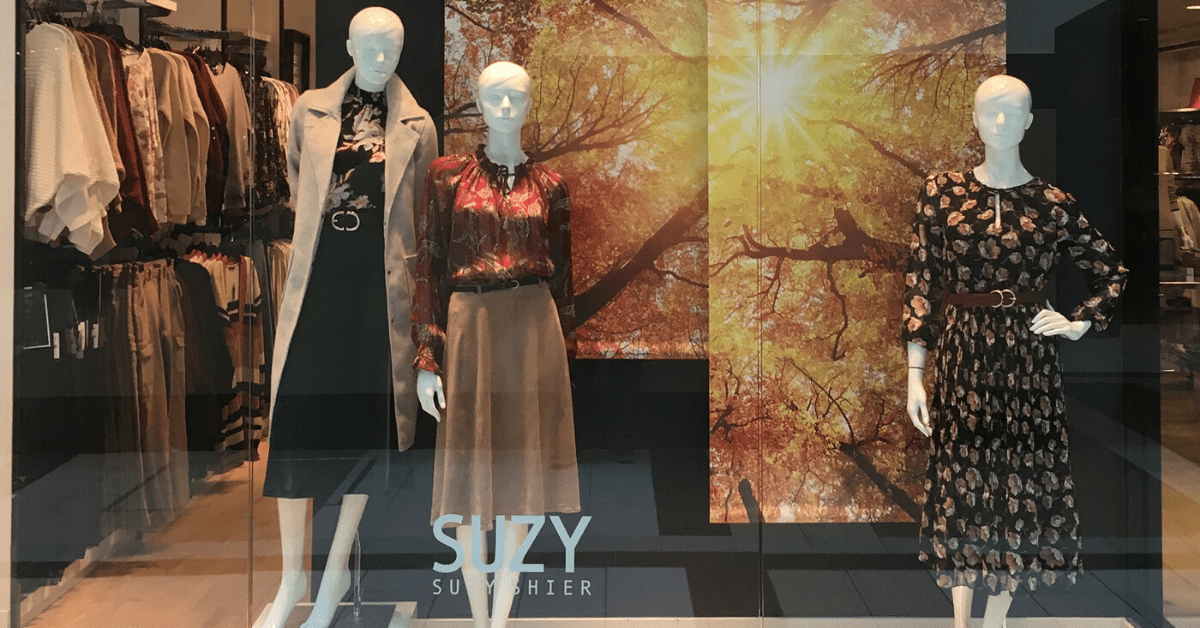
In this context, I had the privilege to speak with Lisa Challis Vice President of Sales and Operations at a leading Canadian female fashion retailer Suzy’s (aka Suzy Shier) as well as their Director of E-Commerce, Nathalie Mansouri.   I asked them how they see this opportunity and how they work on building out that engagement, more specifically the tools that allow them to best engage with their Suzy customers.

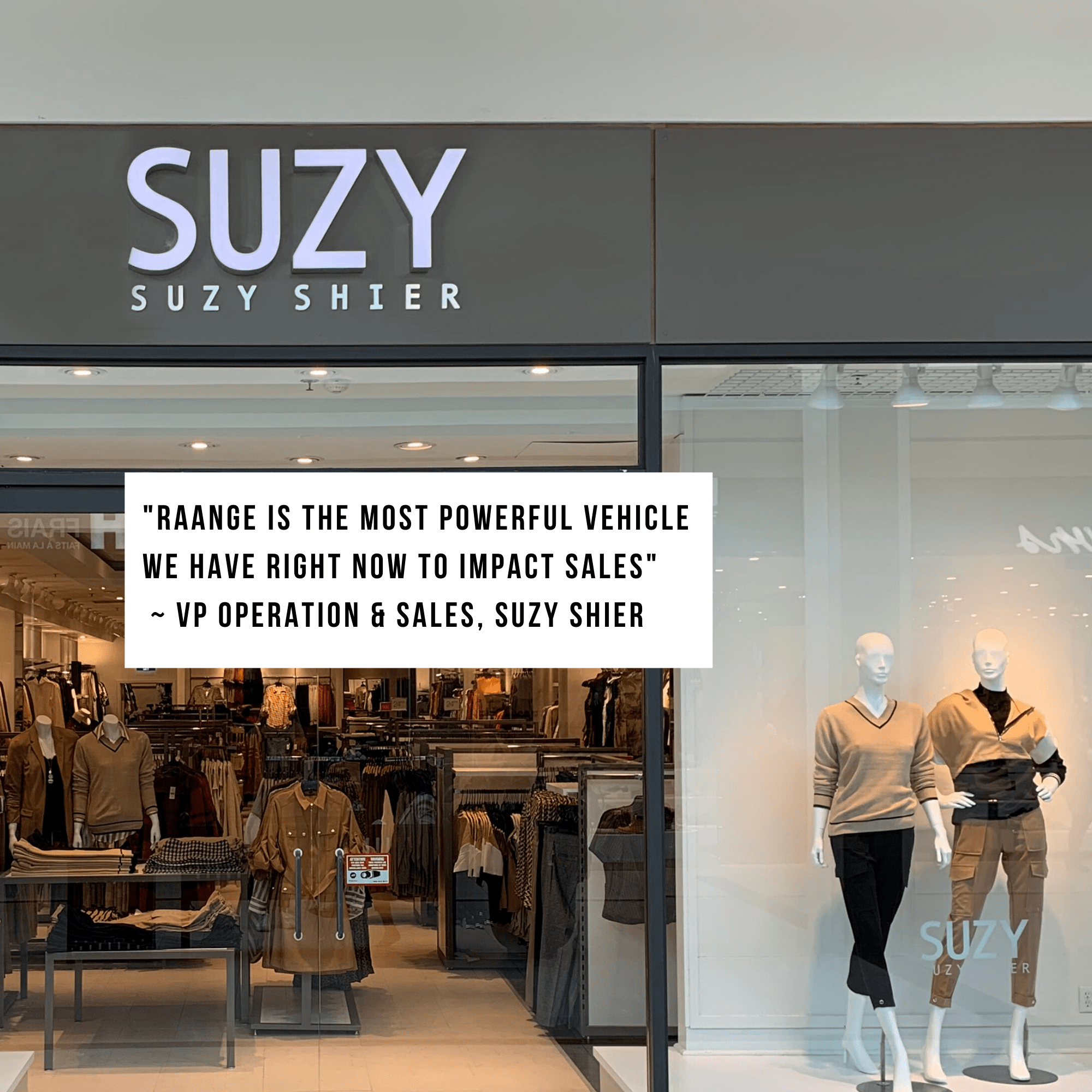
It’s not often that I’ve heard a long-standing retail executive state a technology as “our most powerful vehicle to impact sales and create loyalty”, but those were the exact words that Lisa used when describing her use of Raange’s mobile marketing solution.

In a time where email engagement is declining for Suzy and other retailers, there is a crucial need to have a simple yet effective tool to allow the brand to rapidly engage customers with a true call to action. Like many other retailers, Suzy has several initiatives involving larger technology integrations occurring at once. All that is necessary, but takes up considerable resources. The importance of enabling a simple solution that would require minimal set-up and configuration to allow them, when needed, to be either proactive or reactive in real-time.

Download a PDF copy of this Case Study to take with you!

[hubspot portal=”2510239″ id=”f147ade0-cd0f-4217-91b8-52132345ef2e” type=”form”]

However simple, the Raange solution is also powerful, allowing for a great depth of data capture, massive list building, precise data segmentation (each contact is tracked to the store-level) and localized mobile messaging. This is accomplished without long technology integration cycles.

The optimal workflow facilitated by a best of class mobile marketing solution like RAANGE would go as follows :

Lisa also noted, “We recognize that our customers who are entering our store are often pressed for time. This no longer allows for those longer sales processes that we had in the past, yet they still are looking for that human experience”.

Like most of the retail industry, Lisa also spoke about how more informed their customers are when entering the store, often looking for a specific product discovered online. This also makes the notion of building loyalty, that much more important in an era of almost near-instant gratification. As she put it, “The engagement opportunities need to be clear, rapid and concise.” Lisa also discussed the importance of making this task accountable to everyone on the sales floor and to ensure that it is properly attributed and measured among the sales team’s key performance indicators (KPI’s).

Nathalie spoke to two digital phenomenons provoked by this mobile marketing solution that I found fascinating. On one hand, they discovered that their online conversion driven by SMS was increasing with a younger demographic. This is something all brands, especially those with a long heritage like Suzy, are constantly striving to do to maintain a solid customer base. On the other hand, there was a considerable increase of both online and instore traffic, literally moments after an SMS message was sent.

Lisa and Nathalie noticed that both digital successes weren’t achieved using other messaging tools. These also had the added benefit of being accomplished with owned first-party data, allowing them to continuously build their customer database all while facilitating privacy compliance.

Today, Lisa now considers the Raange adoption along with the subscription to their Prestige Loyalty program as the two most important factors they measure that correlates to business success. They also foresee a day, as they transition into deeper more complex technologies, when they can better use tools like Raange and Prestige to better understand and segment their customers in order to increase personalization. This will, in turn, deliver even greater and more meaningful engagement opportunities.

So, if your business is looking for a rapid, simple and effective solution to more effectively engage with your customers, this is one solution that I highly recommend you consider.

Carl Boutet

Chief Retail Strategist

StudioRx